

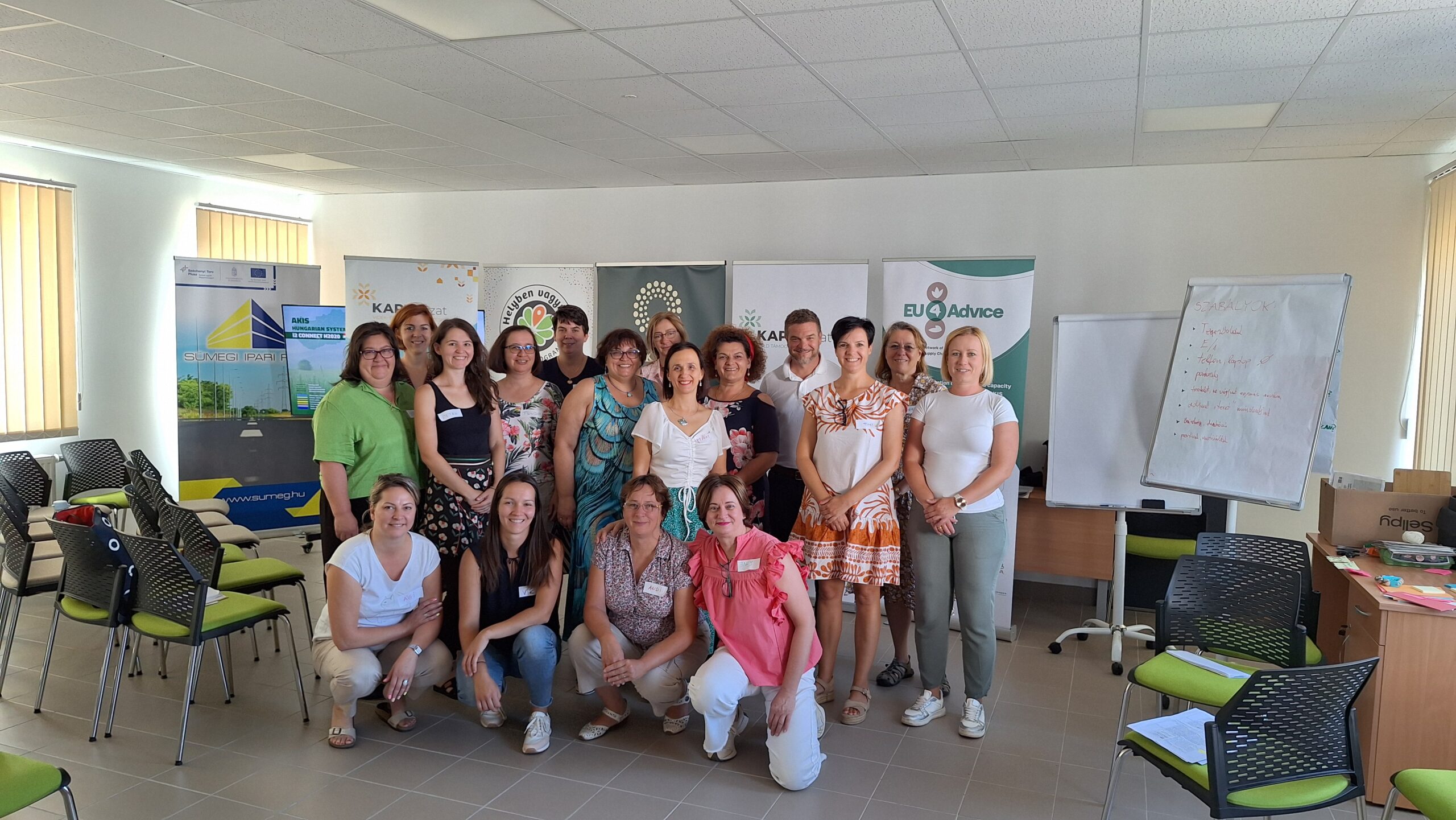
Innovation and cooperation for short supply chains – three-day training for REL mentors in Sümeg
The training of REL mentors and organisers has reached another milestone: between 26 and 28 August 2025, a three-day training course was held in Sümeg, focusing on self-awareness, communication, interactive innovation, networking and their practical application.
The professional basis for the training was provided by the methodology developed in the i2connect Horizon2020 project, which has already proven its effectiveness among agricultural and forestry advisors across Europe. The aim of the Kislépték Association and its partners is to provide mentors who play a key role in the development of short supply chains (REL) with practical tools that support local producers, communities and markets in cooperation, innovation and sustainable development. At their request, the two-day theoretical training was held jointly by Ágnes Jakab (knowledge transfer expert) from the Green Support Unit of the CAP network operating within the National Chamber of Agriculture and Dr. and Dr. András Vér (senior research fellow) from Széchenyi István University, while the practical third day was led by Dr. Katalin Kujáni (president) from the Kislépték Association. Knowledge transfer model (Source: Dr. András Vér) and DISC model (Source: Ágnes Jakab)
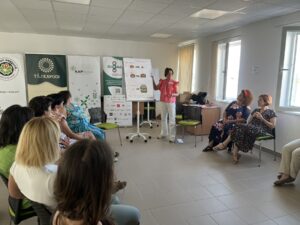
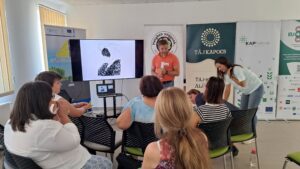
Knowledge transfer model (Source: Dr. András Vér) and DISC model (Source: Ágnes Jakab)
The Kislépték Association is a national professional civil organisation representing the interests of small producers, artisans and local communities. Its mission is to strengthen local food systems and short supply chains (REL) and to support sustainable rural life. The fundamental goal of Kislépték is to facilitate market access for local producers and service providers, as well as to promote environmentally friendly forms of farming that are suited to the characteristics of the landscape, and the associated local processing and marketing systems, short supply chains, and related services through the rationalisation of the legal framework.
An important part of its work is REL mentor and organiser training, which prepares professionals to support community food supply – the creation and maintenance of farmers’ markets, basket communities and local sales formats – through advice and knowledge sharing. As Katalin Kujáni, president of the Kislépték Association, put it, REL mentors and organisers act as “local heroes” helping small producers to access markets and diversify their work.
Within the framework of the EU4Advice and COREnet Horizon Europe programmes, the organisation of a network of REL advisors and mentors has also been launched at EU level, with the development of methodological, training and toolkit support. The aim is to formally integrate REL professionals into national AKIS systems, so that short food chain management is given the same weight in expert advice as areas related to production or environmental management.
Over the past year, the Kislépték Association, in collaboration with Pannon Helyi Termék Nonprofit Kft., has begun to develop this for members of the Helyben Vagyunk trademark network. REL mentors and advisors must have specialised knowledge that goes beyond traditional areas of agricultural consulting – such as crop production, animal husbandry and environmental management – and complements it with expertise in market organisation, community building, short supply chain management and local economic development. In addition, REL mentors and advisors must also equip themselves with so-called soft skills ( ), such as appropriate communication, people skills and empathy, conflict management, etc.
The first day of the training focused mainly on communication training with group work, case studies and creative problem solving. Participants learned about the different elements and types of communication processes and applied them in “REL-specific” situations. They understood what active listening means and how important it is in counselling. The day ended with a “news distortion” training exercise, where they experienced how the content of a story can change when it is passed on from one person to another.
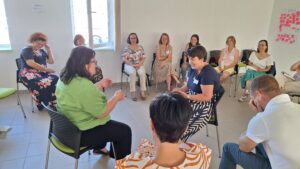
“News distortion” exercise (Source: Ágnes Jakab, NAK)
On the second day, mentors and advisors learned about the Innovation Spiral theory developed as part of the i2connect Horizon2020 project and its practical application. The Innovation Spiral promotes agricultural innovation and builds the capacity of advisors by bringing innovation processes closer to those working in agriculture and making them easier to understand. They also deepened their knowledge of the Agricultural Knowledge and Innovation System (AKIS). They learned about the institutional components of the system and how they are connected to each other, and then were able to place themselves in this system during an exercise. AKIS is a network of relationships between people and organisations that shows how its participants are connected to each other and how it facilitates mutual learning through the sharing of knowledge and information. The afternoon programme continued with an introduction to the DISC personality model, which describes four basic forms of human behaviour. This model can also help REL mentors and organisers to better understand communication, leadership and teamwork. The closing exercise of the day, completing and discussing the assertive communication test (Thomas-Kilmann model), promoted self-awareness, communication and conflict management.
The third day of the training took us to Kékkút, to the Levendula Port with the Helyben Vagyunk trademark, where the REL mentors and counsellors participating in the training were tasked with putting the tools they had learned over the previous two days into practice in a counselling situation. Our hosts, Enid and Tibor, told us the story of their farm, their achievements and their plans for the future, sharing their setbacks and doubts with the audience. The REL team applied what they had learned the previous day well, as we collected the strengths and challenges of the Levendula farm, then grouped the activities and formulated their priorities. In this work process, they made really good use of the elements of the Innovation Spiral from the previous day.
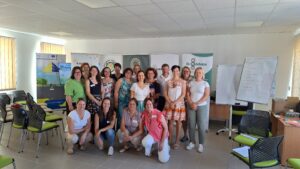
REL mentors and consultants with the trainers (Source: Ágnes Jakab, NAK)
The training in Sümeg once again confirmed that the interactive methodology developed within the i2connect project is also well suited to the work of REL advisors. The participating mentors and organisers not only gained new professional and communication skills, but also had the opportunity to try them out in practice. The training strengthened community-building skills, conflict management and problem-solving – all competencies that are essential for the sustainable operation of local economies and short food chains. With this training, the REL mentor network has taken another step towards strengthening its position in domestic and international advisory systems and effectively supporting small-scale producers, communities and the improvement of rural quality of life in the long term.
You can watch a short video on REL training here.
Authors:
Ágnes Jakab (NAK-ZTE) and Dr. Ágnes Major (Kislépték Association)
Budapest, 8 September 2025


Leave a Reply